Posts

Success does not always mean winning: A report

Image
Success comes in many colours: the red-orange brightness of exactly what we wanted; the bold purple of meaningful response from readers; the pale blue of “good effort” or “honourable mention”. And even the flip side of success — the empty bleak greyness of utter silence — can be felt as a win if we place the experience above the result. Over the past six or so months of writing, I have experienced all these colour variations, and I will use this multi-hued record as motivation for my next six months of writing. Red/orange bright: I will have an essay published on Brevity blog  on Wednesday, April 26, which describes my self-styled writing training program of the past few years. This is my third publication on that blog and I am delighted to be in the company of the fine writers from many corners of the globe who appear there. In the ‘it’s gets even better’ category, back in December, I pitched an essay topic to Brevity magazine — and the editor accepted it on the basis of ...

No paintbrush required: Being creative is not (necessarily) about making art

Image
Recently, I was talking with some people about what makes a good life. I said that I think it includes being creative — that creativity is a key component of living well. But no sooner had I said “creative”, than the cry went up:  “I can’t paint.” “I can’t tell stories.” “I can’t draw a stick figure!” “I can’t write.” Fine. Good. No problem. Because being creative is a state of mind, it’s not about drawing or writing or painting. Of course, it can be. But it doesn’t have to be. At its core, being creative means being ok with that state of mind that settles into wondering, into pondering, into noodling on something — or on nothing, come to that. It’s the state of mind that Guy Claxton calls ‘the tortoise mind’. We each have one, just as we each have a ‘hare mind’, also. It’s just that we have most probably most usually been rewarded for living in our hare mind, for being driven by our hare mind. Claxton describes it like this: The hare mind is the problem solver, whi...

Micro memoirs: Life stories 100 words at a time

Image
  I recently participated in a challenge* to write one 100-word micro memoir every day for five days; each day had a theme that we were encouraged to use as the springboard for our writing. The genre was creative nonfiction, so this challenge was not about inventing stories, but, rather, about going deep into our memory banks to pull on the thread of experiences, big or small, from which to weave stories. If I were to summarize the five stories I wrote, it could go something like this: Once upon a time there was a girl named Amanda, who grew up with cats, so, as an adult, she always had at least one cat in her life. She was good at languages and because she was only 17 when she graduated from high school, she went to France to work as an au pair before returning to Canada to attend university. That first degree got her into a post-graduate journalism program, which she really enjoyed. While she never worked as a front-line journalist, her training became the foundation of her own w...

Why can’t they EN-UN-CIATE!? or Lower the volume, turn up the subtitles

Image
More and more these days, I understand less and less of what the people on television or radio are saying. It’s not that I cannot hear them. I hear the noise of their speech, but I cannot necessarily make out the words. I find myself railing at them, as if I were an old crone elocution teacher: Speak slowly — or maybe not slowly, but for goodness sake EN-UN-CIATE! I am not talking about accents here. I am talking about make the effort to pronounce the words to ensure that the listener can discern them and, thus, make out the meaning of what you’re saying. It is so frustrating to me that so many broadcasters and podcasters think that having a microphone is enough to transmit their message to me. No. They also need to speak clearly and make the effort, take the time, to translate the noise of their words into meaning for my ears via that microphone. I recently learned that it’s not just me. This 10-minute video on Vox’s YouTube channel explains that the problem of hard-to-hear on-air vo...

Writing less can take more, much more, time

Image
In his Lettres Provinciales ,  the French philosopher  and mathematician Blaise Pascal famously wrote:  “I would have written a shorter letter,  but I did not have the time.”    In the second year of my master’s in applied communication, the 50+ students divided quite naturally into two streams: Those who had a core question they wanted to investigate with research and writing into a full-length thesis, and those who preferred to take a broader approach with a selection of courses and one long paper. I was in the second group. For the life of me, I could not come up with one sole question to hold my focus for the final year of study. Instead, one of the profs helped me translate my frustration at the often obtuse and dense articles we had to read into a short-term investigation of discourse conventions across different disciplines. In plain English, this means I investigated how a research paper written by scientists (about the link between exposure to...

Memories of Mexico while watching the snow here (not yet) melt

Image
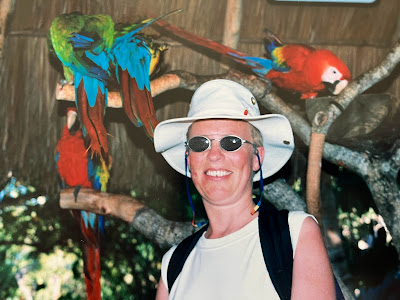
The colourful birds were wonderful.   Once upon a time late in the last century, two women traveled to Mexico. They booked a beachfront apartment, rented a VW Bug, and set off for adventure. In those pre-internet days with rudimentary email communication, it was tricky, but doable, the assumption being that two and two would, indeed, make four. All would work out. And it did. We enjoyed a wonderful late-winter holiday on the Mayan Riviera. The weather was good. The apartment perfect. The car exactly as expected. Even the language barrier didn’t pose a significant problem, thanks to a small phrase book and my willingness to just give it a go. Our apartment was at the very top Back then, 24 years ago, ‘giving it a go’ got us far: From the Cancun airport, along a small track to the apartment and then off to find a place for dinner — all in the dark. It was exciting not daunting. We had adventures every day: in the supermarket buying food, at local cafes figuring our way around a menu...

Down with Daylight Savings Time. Up with morning time.

Image
(with apologies to Dr. Seuss , read the poem below to the rhythm of 'Green Eggs and Ham') I do not like the time change, old I am I do not like it slam damn bam. Would I like it here or there? I would not like it here or there I would not like it anywhere I do not like the switcheroo I do not want it — for me nor you! I think that makes clear I do not like the time change; while longer summer evenings are pleasant, they don’t really last all that many days out of the year’s 365 and, as soon as we reach the summer equinox, we begin the slide down hill towards shorter days anyway. I say, let’s just stick to Standard Time and learn to love it and live with it. After all, it’s not like we actually gain daylight hours; we merely exchange morning light for evening light. Yes, I speak as a morning person. I say, Down with the time change! Up with early morning rising! The history of Daylight Savings Time (DST) has to do with having more daylight at the end of the standard 9-5 work d...